
Joe DiMaggio also fought in World War Two, but his experience was nothing compared to the
“She was always a planner-and she had this all worked out: Joe wasn’t
going to get hurt, wasn’t going to get near any war. Who was running
the Army? Why, men- American men, of course. And every one a
baseball fan. They’d do anything for DiMaggio! They’d carry him around
like a maharajah! So the first thing he had to do was ask for an Army
posting in L.A.” (Cramer; 207).
DiMaggio was then transferred from L.A. to Hawaii. Since the American Navy was off fighting
Warren Spahn, the pitcher who won more games than any other lefty in major league history, served in the army for three years as a combat engineer. “Spahn saw action during the Battle of the Bulge, was wounded in the foot and survived the collapse of the Remagen Bridge in Germany” and he “returned from the war with three battle stars, a citation for bravery and a Purple Heart. Spahn also earned a battlefield commission as second lieutenant, the only major league player to earn such an honor.” (Mondore).
“The biggest wartime problem for American professional baseball was the loss of players to the
To be continued.
A Game at War: Part II


A Game at War: Part I
Baseball has been an integral part of American heritage throughout most of its history. The game of baseball was invented by Abner Doubleday in 1839 and has seen its share of American
Upon returning home from the war, many ballplayers could not return to the diamond because of injuries they sustained while fighting. Despite the negative effect war had on baseball, the game itself encountered a positive “rebirth” during the war years. Baseball became a national pastime, and its importance to America was recognized by one of the nation’s greatest leaders; Franklin Roosevelt. African-Americans were beginning to fill major league rosters. A women’s
American involvement in World War Two did not intensify until the Japanese bombed Pearl Harbor. Then Commissioner, Judge Kennesaw “Mountain” Landis was considering the idea of shutting down baseball until the war ended. Landis wrote to the President, asking if he should allow major league teams to begin spring training. Franklin Roosevelt responded to Kennesaw's inquiry with the now famous Green Light Letter. In the letter, Roosevelt wrote;
“ My dear Judge:
Thank you for yours of January fourteenth . As you will, of course, realize the final decision
I honestly feel that it would be best for the country to keep baseball going. There will be fewer people unemployed and everybody will work longer hours and harder than ever before.
And that means that they ought to have a chance for recreation and for taking their minds off their work even more than before.
Baseball provides a recreation which does not last over two hours or two hours and a half, and which can be got for very little cost. And, incidentally, I hope that night games can be extended because it gives an opportunity to the day shift to see a game occasionally.
As to the players themselves, I know you agree with me that the individual players who are active military or naval age should go, without question, into the services. Even if the actual quality to the teams is lowered by the greater use of older players, this will not dampen the popularity of the sport. Of course, if an individual has some particular aptitude in a trade or profession, he ought to serve the Government. That, however, is a matter which I know you can handle with complete justice.
Here is another way of looking at it - if 300 teams use 5,000 or 6,000 players, these players are a definite recreational asset to at least 20,000,000 of the fellow citizens - and that in my judgment is thoroughly worthwhile.
With every best wish,
Very sincerely yours,
Franklin D. Roosevelt” (www.baseball-almanac.com)
Roosevelt confirmed the fact that baseball had become America’s pastime, and now more than ever, he needed baseball to help Americans pass the time. As Roosevelt asked baseball to help keep American’s worry free for two hours, the military asked a number of ballplayers to enter the service. Roosevelt decided not to exempt current ball players from the draft because he felt the game would not loose its feel if it were played by men who were either too old or too young for the war. Famous players such as Ted Williams, Joe DiMaggio, Bob Feller, and Warren Spahn all served in the United States military in one form or another.
Bob Feller became the first major leaguer to volunteer to fight in the war. Feller lost four years to the war, and by doing so, effectively cost him the chance of obtaining baseball’s three hundred career wins total, a very rare achievement for a pitcher. Feller decided to enlist with the United State’s Navy two days after Pearl Harbor was bombed. Feller served as an “anti-air craft gunner on the battleship Alabama with the Third Fleet. His fleet fought in battles at Tarawa, Iwo Jima and the Marshall Islands.” (Mondore). Also stated in Mondore’s article entitled “1942: When Baseball Went to War” was Feller’s comments regarding his experience with the war. Mondore wrote; “Humble over his own role in the war, Feller went on to state, "I am no hero. I came back. I never met a bullet with my name on it." The anti-air craft gunner earned five campaign ribbons and was studded with eight battle stars. (Mondore).
Ted Williams, the famous outfielder for the Boston Red Sox, served his country as a Marine
To be continued.

Baseball's Great Experiment, Jackie Robinson: Part II
Continued from Part I of 108 Red Stitches tribute to African American Ballplayers, part of a week long series honoring Dr. Marting Luther King, Jr.
After his discharge from the Army, Robinson soon found himself in a new uniform; the uniform of the Kansas City Monarchs, a baseball team in the Negro League. At the time Robinson began playing for the Monarchs, the Negro League had just suffered a setback in attempts to break down the color barrier in baseball. Major League baseball was looking for excuses to keep black players out of the league and eventually struck gold in the form of the black press. In his novel Baseball’s Great Experiment, Jules Tygiel discusses the actions of a prominent member of the black press, Sam Lacy.
“Lacy and other black writers frequently criticized the absence
of fundamentals in the Negro Leagues. Some black athletes
excelled in hitting or fielding or base running, Lacy contended,
but few demonstrated the all-around talent necessary for
success in the majors” (Tygiel; 84).
In attempts to jump start or motivate the players in the Negro Leagues, Lacy wrote “I am reluctant to say that we haven’t a single man in the ranks of colored baseball who could step into the major league uniform and disport himself after the fashion of a big leaguer” (Tygiel; 84). This comment gave the authorities of “white baseball” something to build off of. If their own press didn’t believe that blacks could play in the majors, why should we give them a chance to prove themselves?
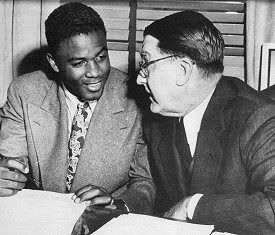
Robinson would continue to play for the Monarchs as the racially driven debate continued. Robinson wasn’t the best player in the Negro Leagues, so it was a surprise to him when the general manager of the Brooklyn Dodgers approached him with an offer to play for his franchise. In an essay written by Peter Dreier titled “Jackie Robinson’s Legacy; Baseball, Race and Politics” the topic of “baseball’s great experiment” is discussed. Dreier writes;
“He (Branch Rickey) knew that if the Robinson ‘experiment’
failed, the cause of baseball integration would be set back for
many years thereafter. He could have chosen other Negro
League players greater talent or name recognition, but he
wanted someone who could be what today we call a ‘role-model’.
Robinson was articulate and well educated. Although born in the
segregated Deep South, he lived among whites in his Pasadena
neighborhood, at school, and in college, and he played on
integrated sports teams.” (44).
Branch Rickey invited members of the press to attend the signing of Robinson to a major league contract. Once the press realized why they had been invited, the room fell eerily quiet. The writers realized this was the beginning of a new era in baseball, and frankly, they did not know how to handle the situation. In a sign of the times Al Parsley, of the Montreal Herald, wrote in his article of Robinson “His color is the hue of ebony. By no means can he be called a brown bomber or a chocolate soldier” (Tygiel; 72). This was a chance for the members of the press to introduce a new ballplayer to the world, but all they could concentrate on was the color of his skin.
Members of the white press began to doubt Rickey’s selection of Robinson to break the barrier. Will Connally, a sportswriter from San Francisco, spearheaded that belief. Connally considered one of Robinson’s U.C.L.A. teammates, Kenny Washington, to be a better pioneer. Connally wrote “Kenny is a ‘white man’, a nice guy. [He] quoted Californians as saying, “Robinson, he’s a troublemaker” (Tygiel; 75-6).
The black press (or members within the black press) treated this situation far more differently than the white press did. Jules Tygiel writes “black newspapers placed the Robinson story on the front page, hailed the breakthrough in their editorials, and devoted a substantial proportion of their papers to the event” (Tygiel; 78-9). Robinson was quickly elevated to the same platform that held the likes of Joe Louis and Branch Rickey quickly became popular in many black communities.
Once Robinson signed on with the Dodgers, he was assigned to their farm team located in Montreal. The Dodgers hoped this would give him some shelter from the American media that would eventually try to break him. A year before Robinson would make his debut with the Dodgers, New York Times columnist Roscoe McGowen wrote in one of his articles “A bit of tradition was shattered today when Negroes were seated throughout the stands. Heretofore they have sat only in the small bleachers back of first base reserved for them. Possibly the Jackie Robinson influence...” (McGowen). In his essay “The Greatest Season, From Jackie Robinson to Sammy Sosa”, Roger Kahn writes about the task Robinson was about to undertake;
“With precious little help from the press, the umpires, and the
other ball players, Jackie Robinson integrated major league
baseball in 1947. [...] The policy of segregation that began in
1885 was unofficial and absolute. No documents attest to
baseball’s apartheid. There was simply an understanding among
every major league club owner and every minor league club owner
for more than sixty years that no blacks could play in so-called
organized ball.” (Kahn; 38).
Robinson’s entry into the league caused quite a stir amongst baseball officials. An article ran in the New York Times with different officials perspectives on Branch Rickey’s newest signing. Frank Shaughnessy, the president of the International League (where Robinson would play in the minors) confirmed what Kahn had written in his article on race relations in baseball;
“There’s no rule in baseball that says a Negro can’t play with a
club in organized ball. As long as any fellow’s the right type and
can make good and can get along with other players, he can play
ball” (Club Heads Give Views; 17).
Clark Griffith, the President of the Senators believed that baseball had no right “stealing” players from the Negro Leagues when he stated “The only question that occurs to me is whether organized ball has the right to sign a player from the Negro League. That is a well-established league and organized baseball shouldn’t take their players. The Negro league is entitled to full recognition as a full-fledged baseball organization” (Club Heads Give Views; 17). In short, Griffith was stating that blacks should stay where they belong, in the Negro Leagues. Horace Stoneham’s response to the signing of Robinson wasn’t much brighter; “the primary responsibility we have is finding places for our returning Service men, numbering into the hundreds, and only if they prove incapable will new players (blacks) be placed on our clubs.” (Club Heads Give Views; 17).
To be continued.

Baseball's Great Experiment: Jackie Robinson, Part I
In honor of Martin Luther King Day, the staff here at 108 Red Stitches decided honor King's Legacy by writing about African
The Constitution says that “all men are created equal”. African Americans served with honor throughout World War One and World War Two. In the North, many African Americans were beginning to realize the dreams their ancestors laid out before them. America, during the middle of the 1940’s and the early 1950’s was undergoing a period of change. Change (although slow at first) effected everything except for the heart of America; baseball. Baseball has been given the title “America’s Pastime”, and up until the end of the second World War, baseball had refused to break down the color barrier that had clouded the game. All that would change with the help of “the founder of the farm system” and a no-name from the Negro Leagues.
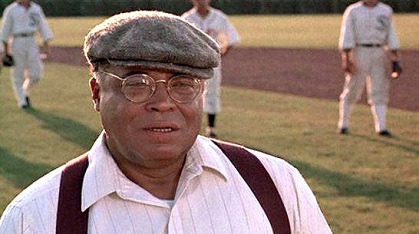
In the film “Field of Dreams” Terrance Mann (played by James Earl Jones) says;
“The one constant through all the years has been baseball.
America has rolled by like an army of steamrollers. It’s been
erased like a blackboard, rebuilt, and erased again. But baseball
has marked the time. This field, this game, is a part of our past. It reminds us of all that once was good, and what could be again.”(baseball-almanac.com)
There has never been a greater quote used to describe baseball, and never has their been a quote like this that so accurately depicts what Branch Rickey and Jackie Robinson were trying to accomplish during the Summer of 1947; erase America’s blackboard and rebuild it.
Born Jack Roosevelt Robinson on January 31, 1919, the son of a farmer from Cairo, Georgia would soon face one of life's many hardships that would shadow his life. His father, Jerry Robinson, (owner of a small farm) eventually grew weary of the monotonous motion of his life, and ran away to Florida with another woman. Jackie’s mother decided that Cairo was no place to raise her family, so they moved to Pasadena, California. In his book, Jackie Robinson, A Life Remembered, Maury Allen interviewed Mack Robinson, one of Jackie’s older brothers. Mac said “What my mother didn’t know, when she brought us here, what none of us knew, was that Pasadena was as prejudiced as any town in the South. They let us in alright, but they wouldn’t let us live” (Allen; 19).
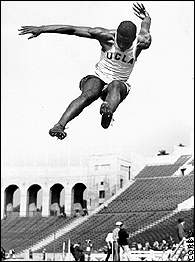
Robinson would eventually attend UCLA because of the college’s proximity to his mother. There, Robinson excelled in football, basketball, and most importantly baseball. It was after his college days that Jackie Robinson began to show a glimpse of what was to come.
Just before being deployed oversees to fight in World War Two, Robinson engaged in a dispute that almost ended his military career in disgrace. Robinson got on a bus at Camp Hood (his
“Clearly, almost all of the whites involved were genuinely
mystified that Robinson disliked being badly treated. The white
private, Ben Mucklerath, denied that he had called Robinson a
nigger, as Robinson charged; but Corporal Elwood, the first MP
on the scene, testified the Mucklerath ‘came over to the pickup
and asked me if I got that nigger Lieutenant. Right then the
Lieutenant said, ‘ Look here, you s son-of-a-bitch, don’t you call
me no nigger’. (Rampersad; 107)
Robinson’s testimony to those hearing the court martial open a portal that reveals the strength and intestinal fortitude that he latter called upon when dealing with the media during his baseball career. Robinson took the stand, on his own free will, and delivered a speech that would effect the outcome of his trial;
replied: “I looked it up once, but my grandmother gave me a good
definition, she was a slave, and she said the definition of the word
was a low, uncouth person, and pertains to no one in particular; but I
don’t consider that I am low and uncouth. I looked it up in the
dictionary afterwards and it says the word nigger pertains to the
negroid or negro, but it is also a machine used in a saw mill for pushing
logs into the saws. I objected to being called a nigger by this private
or by anybody else. When I made this statement that I did not like
to be called a nigger, I told the Captain, I said, ‘If you call me a nigger,
I might have to say the same thing to you...I don't not consider
myself a nigger at all,I am a negro, but not a nigger.’ (Rampersad; 108).
Robinson was soon after acquitted of all charges against him, but the trail lasted long enough where Robinson wasn’t able to meet up with the rest of his battalion, who had just left for Omaha Beach. “On November 28, 1944, Robinson was ‘honorably relieved from active duty’ in the U.S. Army ‘by reason of physical disqualification’ (Rampersad; 111).
After his discharge, Robinson soon found himself in a new uniform.
To be continued.
Feeds

get latest updates on news and subscribes to our feeds


