
The final installment in 108 Red Stitches tribute to African American ballplayers in honor of Martin Luther King, Jr. Continued from Part IV.
Branch Rickey was able to step up to bat for Jackie while he was being torn apart in the papers. Rickey stated that “Jackie’s the same high-class boy he was the first year we brought him up. He’s entitled to all the rights of any other American citizen. He’s a great competitor and resents any violations of those rights” (Rampersad; 207). In response to Lacy’s attacks on the Dodger and Robinson’s occasional out bursts, Rickey retaliated saying;
“Perhaps he has lost his temper occasionally the same as any white player would do. But he’s been sorry for it afterward and has used good judgment. We couldn’t have picked a finer boy than Robinson for our experiment of introducing a Negro into organized baseball” (Rampersad; 207).
Robinson was under a considerable amount of stress at the time. The hate mail, death threats, being in the nation’s spotlight, constant badgering from the press, and being “broken into the league” with high and inside fastballs all began to take their toll on Jackie. In an interview with Robinson biographer, Arnold Rampersad, Rachel Robinson (Jackie’s wife) began to worry about Jackie’s well being;
“In those months, according to Rachel, Jack’s worries ‘were eating at his mind, for he would jerk and twitch and even talk in his sleep, which was not like him.” Sometimes he would raise his voice in anger, but anything more violent was out of the question.
Aware of his ordeal, she tried hard to make their home a haven, which Jack appreciated; he had little interest in going out with the boys.” (Rampersad; 180).
Robinson’s standings with the press would eventually change dramatically, and with surprising
Branch Rickey set up an “invitation” from the House Un-American Activities Committee so that Robinson’s growing voice could be heard. Robinson explained to the Committee that in no way did he consider himself an expert on communism or any other type of political organization. According to an article that ran in the New York Times, Robinson did “ask to be put down as ‘an expert on being a colored American, with thirty years of experience at it.’ ” (Trussell; 1). Robinson quickly took the opportunity to denounce racism, many years before the advent of the Civil Rights Movement. Robinson was able to convey to the Committee his love for his country and his willingness to defend it.
Despite his efforts to appear patriotic and expose the racial inequalities his people faced, the remarks against Robeson were what caught the attention of the press and the American people;
“I’m not fooled because I’ve had a chance open to very few Negro Americans,” stated Robinson. He vowed to continue fighting racial discrimination in sports and other areas. At the same time, Robinson rejected Robeson’s assertion that blacks would not fight for the United States;
‘I’ve got too much invested for my wife and child and myself in the future of this country, and I and other Americans of many races and faiths have too much invested in our country’s welfare, for any of us to throw it away for a siren song sung in bass” (Tygiel; 334).
The “siren song sung in bass” Robinson was referring to pointed fingers at Robeson. Robinson believed that Robeson was “shooting from the hip” in his remarks, and felt that his (Robeson) voice did not speak for the entire African American race. Members of the press, however, focused on Robinson’s criticism of the African American Icon, rather than what Robinson had hoped to shed light on; racism in America.
The press, after the Robeson bashing, began to take sides; the white press began supporting Jackie, while the black press remained critical of its bright star. The New York Post ran parts of his speech to the Committee under an editorial entitled “Credo of an American”. The Daily News, ended its editorial piece on the event with ‘Quite a man this Jackie Robinson. Quite a ball player. And quite a credit, not only to his own race, but to all the American people” (Rampersad; 215).
A New York Times article reported that a Democratic Representative from New York, Arthur G. Klein, proposed “that Congress print 500,000 copies of a statement made July 18 before the House Un-American Activities Committee by Jackie Robinson” (No Author; 39). Klein said in a letter to Representative Mary T. Norton (D-New Jersey, chairman of House Administration Committee) “This great American athlete has spoken successfully for all minorities-and for all Americans” (No Author; 39).
The black press was more critical of Robinson; they felt as if he had become a puppet for the white press. They felt as if Robinson was playing into their hands, or buying the white press’ agenda. “To the New York Age newspaper, Harlemites were split sharply on the issue. Robinson had come back from Washington, ‘in the duel role’ of leader of his race and ‘handkerchief head’ ” (Rampersad; 215).
What Jackie didn’t realize was that in negating Robeson’s remarks and by testifying against him, he destroyed what respect and admiration any blacks had left for the influential Robeson. The House got exactly what they wanted from Robinson; a way to remove the “un-American Activist” from public light.
Some members of the black press, like the Baltimore Afro-American, felt that Robinson did more to spearhead a movement against racism then to knock Robeson’s communist remarks; “The Baltimore Afro-American reported that HUAC’s maneuver in summoning Robinson had ‘boomeranged’, in that he had been much more severe on racism that communism. Its headline read: ‘Jackie Flays Bias in Army’ ” (Rampersad; 215).
Throughout his first three seasons with the Brooklyn Dodgers, Robinson was constantly in the nations spotlight and forever a target of the press. His every move, every word, every breath, was under constant watch by both the white and the black press. Living under these conditions took its toll on Robinson, and he would need an outlet off the field to vent his frustrations. One would imagine that Robinson could find a type of peace on the baseball diamond, but the stands, filled with bigots, hatred, and racism only added to the discomfort that came with being a pioneer. In his essay “The Greatest Season” Roger Kahn wrote of a visit he had with Robinson, shortly before his death;
“Before his death, I was visiting the Robinsons in North Stamford, Connecticut, and Mrs. Robinson,Rachel, whom we call Rae, said, ‘No single reporter, not one has ever asked me this. If Jack had a hard day at the ballpark, if the bigots were yelling at him, did he take it out on family when he got home? He didn’t,’ she said. ‘The only way I could tell was that he’d take a bucket of golf balls and his driver and start hitting them off the back lawn into the lake.’ Then Jack looked at me and his eyes were twinkling. “The golf balls,’ he said, ‘were white’ ” (Kahn; 42).
Jackie Robinson set out to do the impossible; he was going to break down the color barrier that cast a dark shadow over America’s pastime and he accomplished that task with the utmost candor and respect. He blazed a trail for the likes of black superstars of the future. Willie Mays, Hank Aaron, Roberto Clemente, Sammy Sosa, and for those who follow in his path, all owe an infinite amount of gratitude to Robinson.
Hank Aaron once said “I hope black kids today can learn what Jackie went through, what I
On April 15, 1997 Major League Baseball retired Jackie
Ten years later, on the 60th Anniversary marking Robinson's entry into baseball, Robinson was again honored, this time, by having every player in the league don his number.
Baseball's Great Experiment, Jackie Robinson: Part V


Baseball's Great Experiment, Jackie Robinson: Part II
Continued from Part I of 108 Red Stitches tribute to African American Ballplayers, part of a week long series honoring Dr. Marting Luther King, Jr.
After his discharge from the Army, Robinson soon found himself in a new uniform; the uniform of the Kansas City Monarchs, a baseball team in the Negro League. At the time Robinson began playing for the Monarchs, the Negro League had just suffered a setback in attempts to break down the color barrier in baseball. Major League baseball was looking for excuses to keep black players out of the league and eventually struck gold in the form of the black press. In his novel Baseball’s Great Experiment, Jules Tygiel discusses the actions of a prominent member of the black press, Sam Lacy.
“Lacy and other black writers frequently criticized the absence
of fundamentals in the Negro Leagues. Some black athletes
excelled in hitting or fielding or base running, Lacy contended,
but few demonstrated the all-around talent necessary for
success in the majors” (Tygiel; 84).
In attempts to jump start or motivate the players in the Negro Leagues, Lacy wrote “I am reluctant to say that we haven’t a single man in the ranks of colored baseball who could step into the major league uniform and disport himself after the fashion of a big leaguer” (Tygiel; 84). This comment gave the authorities of “white baseball” something to build off of. If their own press didn’t believe that blacks could play in the majors, why should we give them a chance to prove themselves?
Robinson would continue to play for the Monarchs as the racially driven debate continued. Robinson wasn’t the best player in the Negro Leagues, so it was a surprise to him when the general manager of the Brooklyn Dodgers approached him with an offer to play for his franchise. In an essay written by Peter Dreier titled “Jackie Robinson’s Legacy; Baseball, Race and Politics” the topic of “baseball’s great experiment” is discussed. Dreier writes;
“He (Branch Rickey) knew that if the Robinson ‘experiment’
failed, the cause of baseball integration would be set back for
many years thereafter. He could have chosen other Negro
League players greater talent or name recognition, but he
wanted someone who could be what today we call a ‘role-model’.
Robinson was articulate and well educated. Although born in the
segregated Deep South, he lived among whites in his Pasadena
neighborhood, at school, and in college, and he played on
integrated sports teams.” (44).
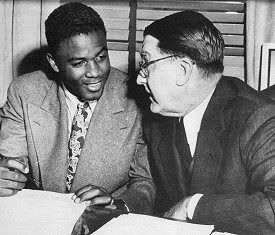
Branch Rickey invited members of the press to attend the signing of Robinson to a major league contract. Once the press realized why they had been invited, the room fell eerily quiet. The writers realized this was the beginning of a new era in baseball, and frankly, they did not know how to handle the situation. In a sign of the times Al Parsley, of the Montreal Herald, wrote in his article of Robinson “His color is the hue of ebony. By no means can he be called a brown bomber or a chocolate soldier” (Tygiel; 72). This was a chance for the members of the press to introduce a new ballplayer to the world, but all they could concentrate on was the color of his skin.
Members of the white press began to doubt Rickey’s selection of Robinson to break the barrier. Will Connally, a sportswriter from San Francisco, spearheaded that belief. Connally considered one of Robinson’s U.C.L.A. teammates, Kenny Washington, to be a better pioneer. Connally wrote “Kenny is a ‘white man’, a nice guy. [He] quoted Californians as saying, “Robinson, he’s a troublemaker” (Tygiel; 75-6).
The black press (or members within the black press) treated this situation far more differently than the white press did. Jules Tygiel writes “black newspapers placed the Robinson story on the front page, hailed the breakthrough in their editorials, and devoted a substantial proportion of their papers to the event” (Tygiel; 78-9). Robinson was quickly elevated to the same platform that held the likes of Joe Louis and Branch Rickey quickly became popular in many black communities.
Once Robinson signed on with the Dodgers, he was assigned to their farm team located in Montreal. The Dodgers hoped this would give him some shelter from the American media that would eventually try to break him. A year before Robinson would make his debut with the Dodgers, New York Times columnist Roscoe McGowen wrote in one of his articles “A bit of tradition was shattered today when Negroes were seated throughout the stands. Heretofore they have sat only in the small bleachers back of first base reserved for them. Possibly the Jackie Robinson influence...” (McGowen). In his essay “The Greatest Season, From Jackie Robinson to Sammy Sosa”, Roger Kahn writes about the task Robinson was about to undertake;
“With precious little help from the press, the umpires, and the
other ball players, Jackie Robinson integrated major league
baseball in 1947. [...] The policy of segregation that began in
1885 was unofficial and absolute. No documents attest to
baseball’s apartheid. There was simply an understanding among
every major league club owner and every minor league club owner
for more than sixty years that no blacks could play in so-called
organized ball.” (Kahn; 38).
Robinson’s entry into the league caused quite a stir amongst baseball officials. An article ran in the New York Times with different officials perspectives on Branch Rickey’s newest signing. Frank Shaughnessy, the president of the International League (where Robinson would play in the minors) confirmed what Kahn had written in his article on race relations in baseball;
“There’s no rule in baseball that says a Negro can’t play with a
club in organized ball. As long as any fellow’s the right type and
can make good and can get along with other players, he can play
ball” (Club Heads Give Views; 17).
Clark Griffith, the President of the Senators believed that baseball had no right “stealing” players from the Negro Leagues when he stated “The only question that occurs to me is whether organized ball has the right to sign a player from the Negro League. That is a well-established league and organized baseball shouldn’t take their players. The Negro league is entitled to full recognition as a full-fledged baseball organization” (Club Heads Give Views; 17). In short, Griffith was stating that blacks should stay where they belong, in the Negro Leagues. Horace Stoneham’s response to the signing of Robinson wasn’t much brighter; “the primary responsibility we have is finding places for our returning Service men, numbering into the hundreds, and only if they prove incapable will new players (blacks) be placed on our clubs.” (Club Heads Give Views; 17).
To be continued.

Feeds

get latest updates on news and subscribes to our feeds


